
Precision under fire: how data-driven strategy saved the Tuan Mill
A live fire near Maryborough, a sixteen-hour forecast, and an incident action plan built on it — with no impact on the mill or the plantation.
- Client
- HQPlantations (HQP)
- Asset at risk
- Hyne Timber Tuan Mill and southern pine compartments
- Ignition
- Native vegetation north of the mill
- Simulation
- 16-hour forward projection, live weather
- Used for
- Incident Action Plan, firebreak siting, resource allocation
- Forecast window
- 16 hrs
- Impact on mill or plantation
- Zero
Certainty the incident management team could plan against.
Fire controlled with no loss to the timber mill or pine compartments.
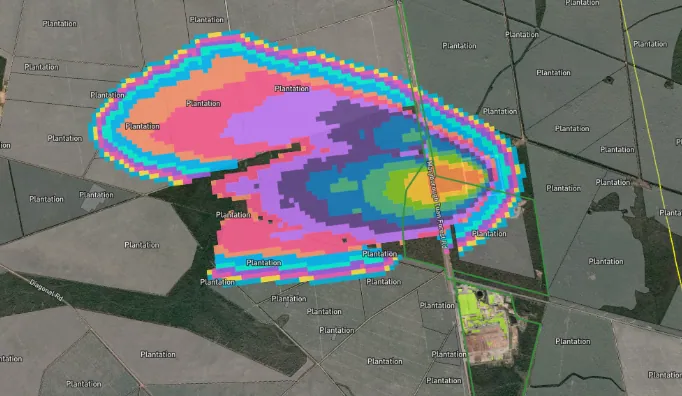
At FiSci our goal is to turn complex environmental data into the kind of clarity that saves assets and protects communities. A fire near Maryborough gave us a real-world demonstration of that mission in action. Using Mitigate, HQPlantations moved beyond reactive suppression and into data-driven strategic control.
The scenario: threat to a critical hub
The ignition occurred in native vegetation north of the Hyne Timber Tuan Mill — a cornerstone of Queensland’s timber processing industry, and a vital customer for HQP. With the fire burning close by, the immediate question was whether it would track south toward the facility, or deep into HQP’s valuable southern pine compartments.
In high-pressure fire scenarios the fog of war leads to difficult, high-stakes decisions. Without precise forecasting, teams can be forced into emergency defensive burn-outs near customer assets — a move that carries significant risks of its own.
From prediction to prevention
Working with the platform, HQP Corporate Fire Manager Andrew Dunn ran a simulation for the forthcoming sixteen hours. Ingesting real-time terrain data, fuel loads and the specific meteorological conditions of the day, the model returned two critical insights.
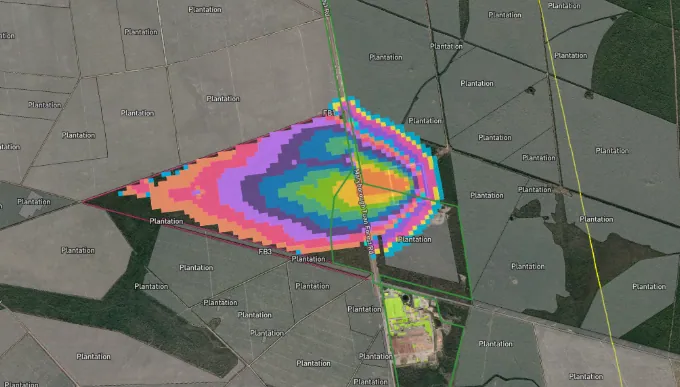
The path of least resistance. The initial simulation showed the fire spreading westerly, away from the Tuan Mill — confirming that under the conditions of the day, the mill was not at immediate risk of being burnt out by the advancing front.
Tactical validation. While the mill was safe, the fire was still predicted to encroach on HQP’s southern pine compartments. Andrew used Mitigate to model the predicted run and inform the Incident Management Team and on-ground firefighters on suppression strategy, tactics and the resources required. It was also used to locate potential firebreaks north and south of the projected spread.
The simulation showed specific breaks the HQP fire team could use over the predicted time frame to bring the fire under control. It also carried fire behaviour information — estimated rate of spread, fireline intensity, flame height — the detail firefighters need to keep themselves and the community safe while deciding how best to tackle the fire.
The reality check: prediction against observation
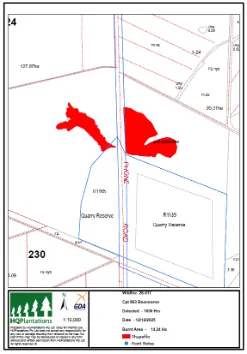
The actual burn area mirrored the simulation’s projected path, validating the tactical decisions made in the early hours of the incident. That level of precision lets fire managers allocate resources with surgical efficiency — crews go where the fire will be, not where it might be.
Strategic confidence in action
This was not a theoretical exercise. The HQP team took the data Mitigate generated and applied it directly to the Incident Action Plan. The result was a textbook success: the fire was brought under control with no impact on the pine plantation or the timber mill, through targeted and weighted suppression informed by the model — with contingency in place had the fire progressed to the full modelled extent.
Daniel Pfrunder, HQP’s General Manager of People, Safety & Risk, observed that the tool’s greatest value was the confidence it gave the executive team. With a clear sixteen-hour window, CEO Jason Wilson and the management team could stay the course, knowing their strategy was backed by science.
A resilient future
The Maryborough incident shows that the future of forestry safety lies in the marriage of field expertise and advanced simulation. By using Mitigate, HQP is making sure that when the next fire starts, they are not just reacting to the flames — they are ahead of them.