
Liverpool Range Wind Farm: a dual threat across 68,727 hectares
Protecting 287 proposed turbines from the landscape — and protecting the landscape from the turbines.
- Site
- Liverpool Range Wind Farm, NSW
- Area
- 68,727 hectares
- Assets
- 287 proposed turbines, houses, sheds
- Terrain
- Undulating, driving increased uphill fire activity
- Fuel load
- 5 to 20+ t/ha, primarily grassy understory
- Conditions modelled
- Catastrophic
- Turbines assessed
- 287
- Site area
- 68,727 ha
- Sir Ivan Fire, 2017
- 55,000 ha
Every proposed turbine scored for risk to and risk from.
Modelled at full resolution under catastrophic conditions.
The historical event the site's risk profile is measured against.
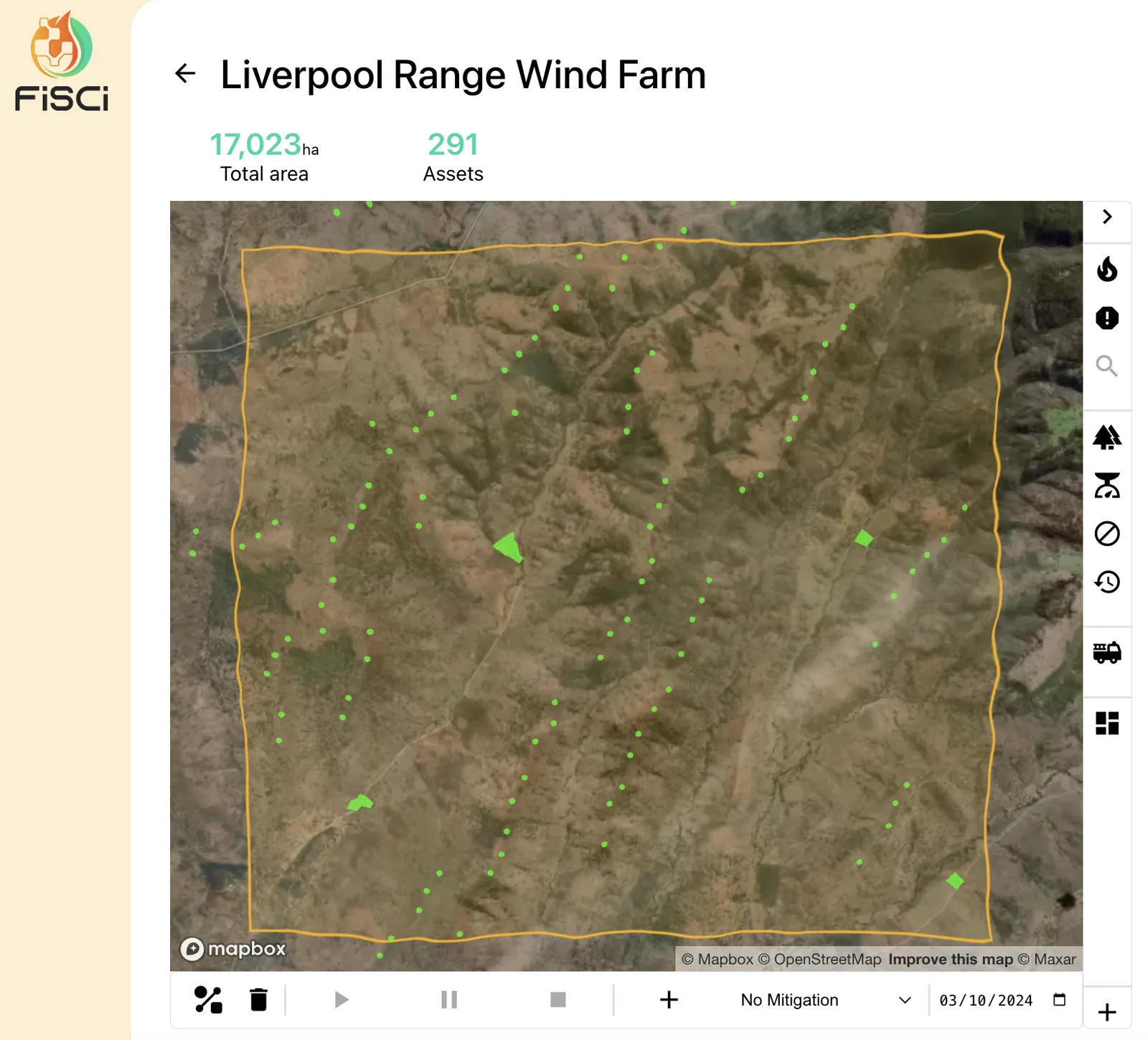
Large-scale renewable energy projects carry a dual threat: protecting high-value turbine infrastructure from bushfire spreading in from outside, and mitigating the risk of a fire igniting at the infrastructure and spreading into the surrounding country.
The Liverpool Range Wind Farm site covers 68,727 hectares in a region with a history of catastrophic fire — including the 55,000-hectare Sir Ivan Fire of 2017, which destroyed 35 homes and 133 outbuildings and killed more than 2,100 head of livestock and domestic animals. That history demands a proactive strategy for 287 proposed turbines and the communities around them.
Site analysis
Mitigate visualises the proposed turbines and predicted fuel load across the site against the project’s single major historical fire, giving a clear visual baseline:
- Undulating terrain, driving increased uphill fire activity.
- Moderate fuel loads, primarily grassy understory, between 5 and 20+ t/ha.
- Proposed turbine sites and other assets, including houses and sheds.
Threat to the infrastructure
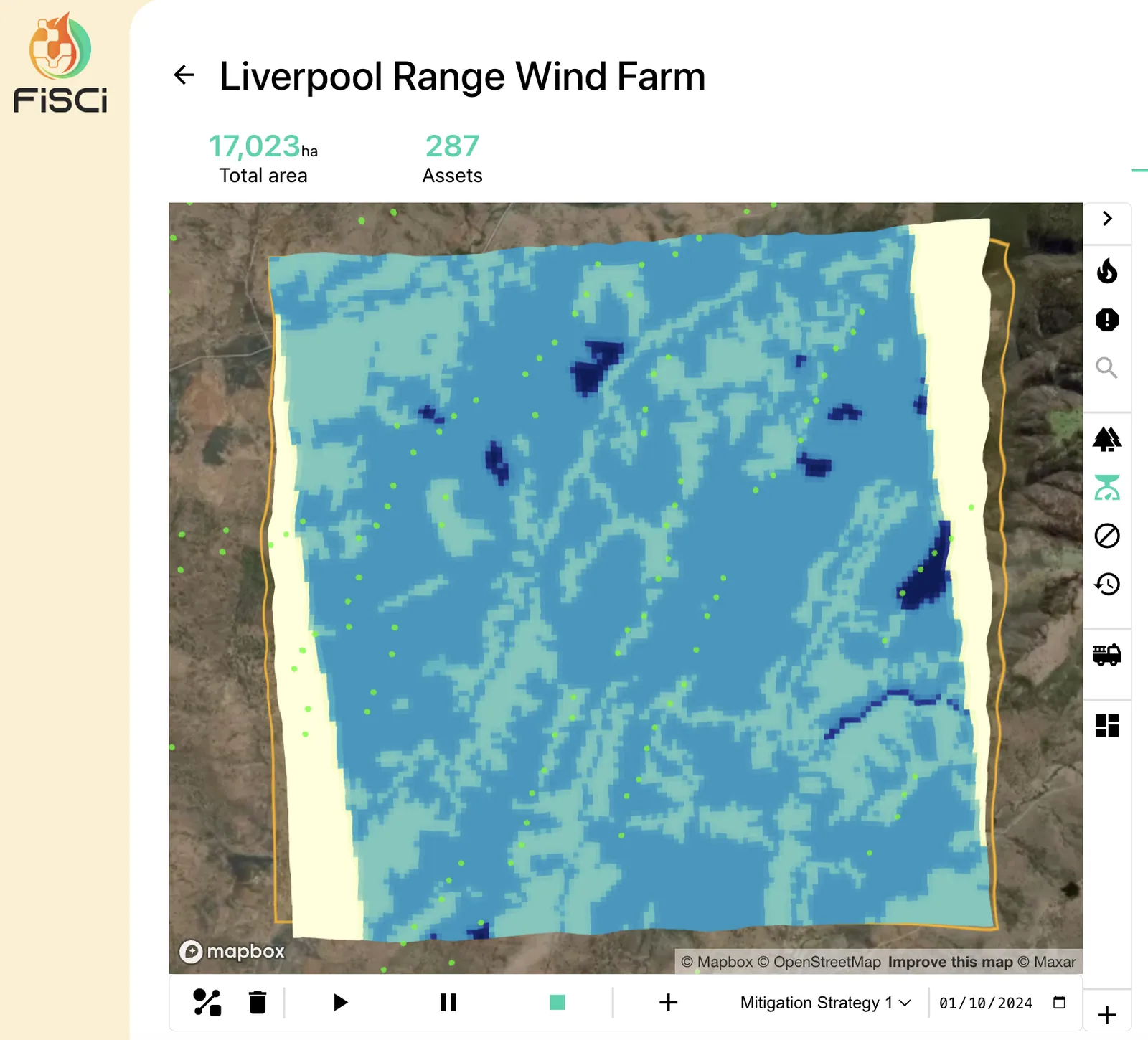
We set a grid of potential ignition locations across the region and ran a fire spread simulation from each under extreme environmental parameters. That quantified which specific turbines were most likely to be impacted by external fires, and which ignition points would produce the largest and most dangerous fires — a complete risk profile for the asset network.
The analysis surfaced a small pocket of denser fuel in the central north of the site putting a number of turbines at risk should it ignite.
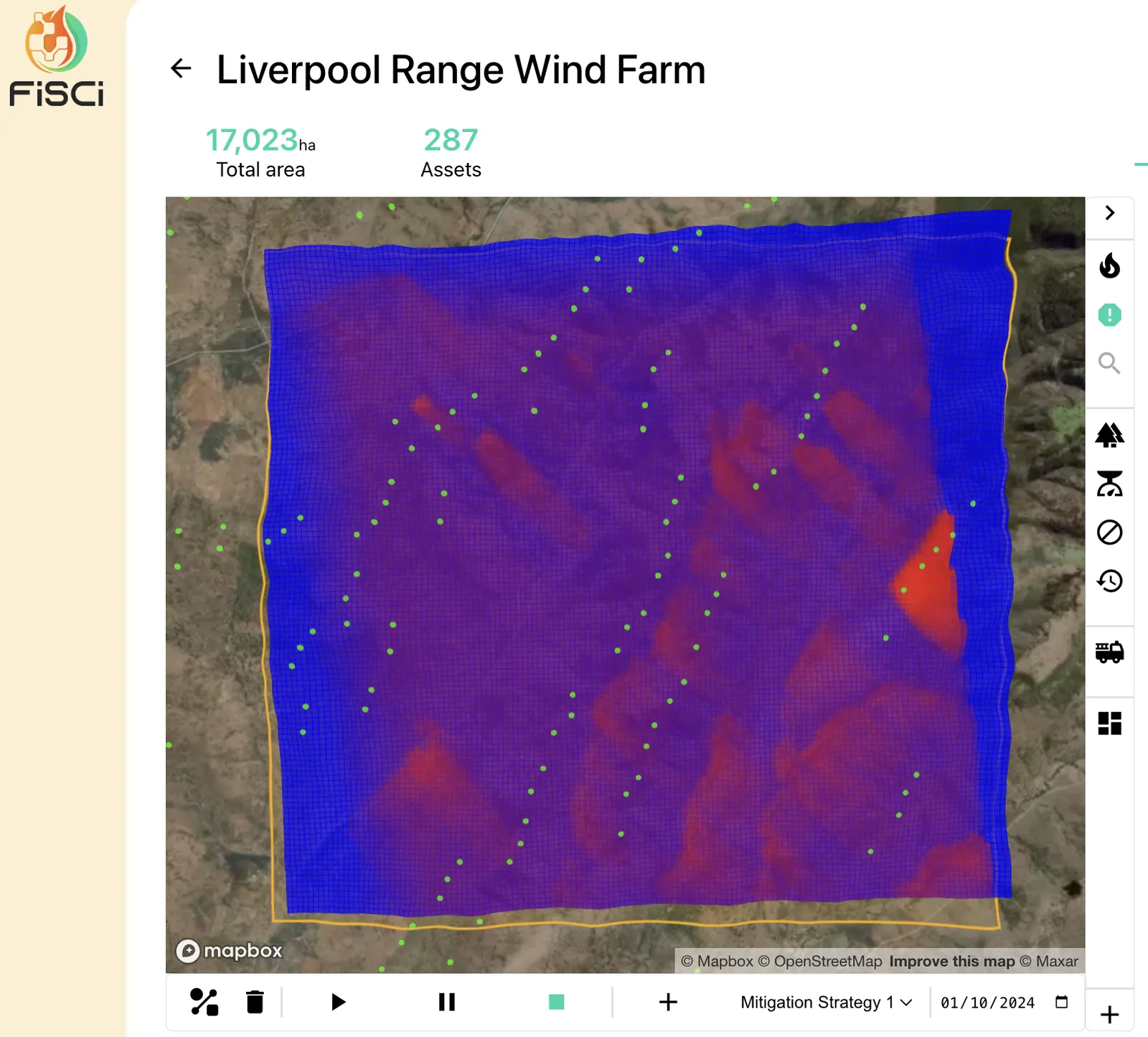
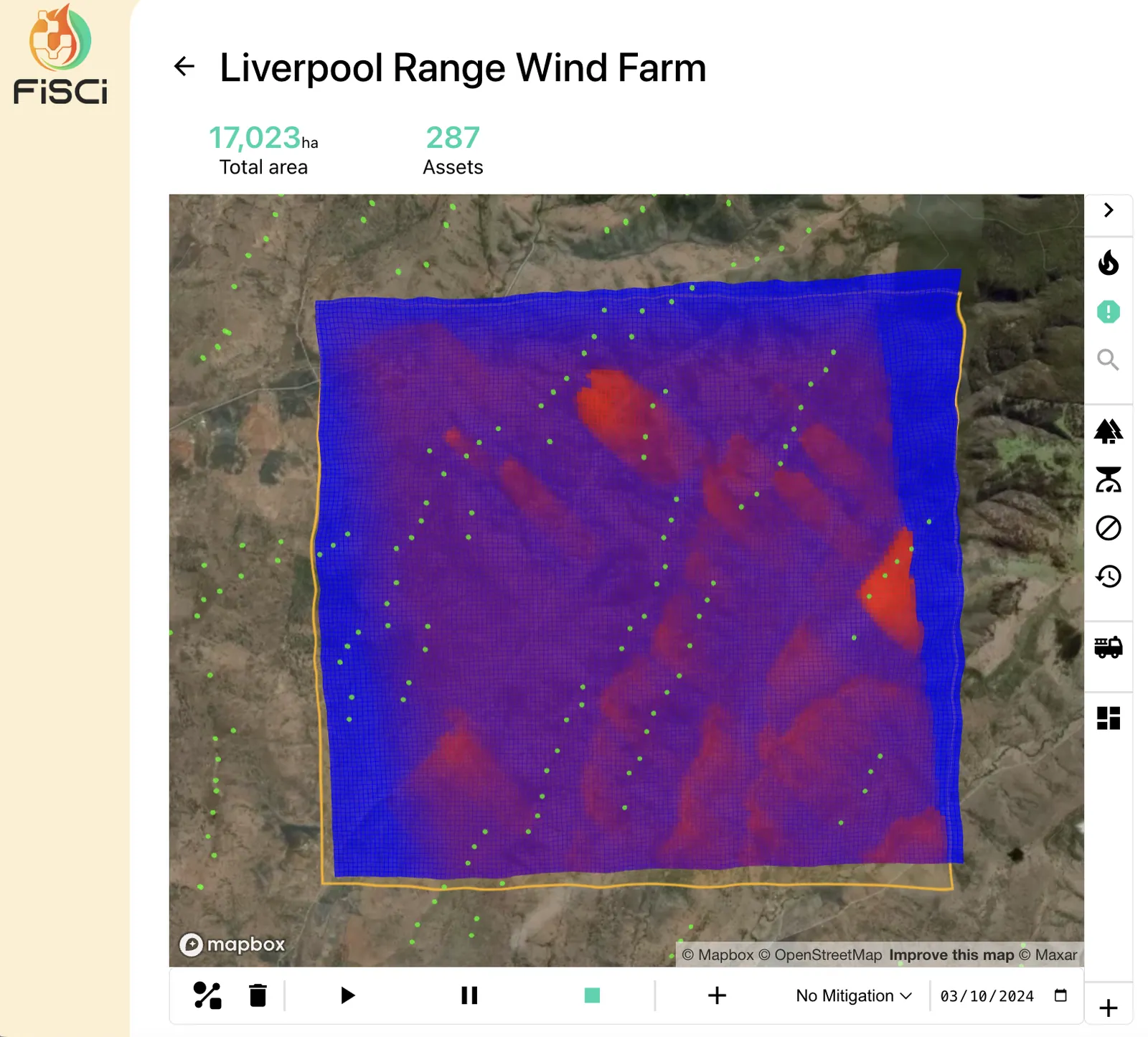
Treating that pocket significantly reduces the fire risk to the turbines in the central north — demonstrating the platform’s ability to model the effect of a planned treatment precisely, and confirming that targeted fuel reduction is highly effective at increasing the resilience of high-value assets.
Threat from the infrastructure
The second question runs the other way. We ran a further set of simulations igniting at the turbines, under the same catastrophic conditions, to identify high-consequence ignition points — the turbines which, if they caused a fire through equipment failure, would produce the largest and most destructive fires across the project area.
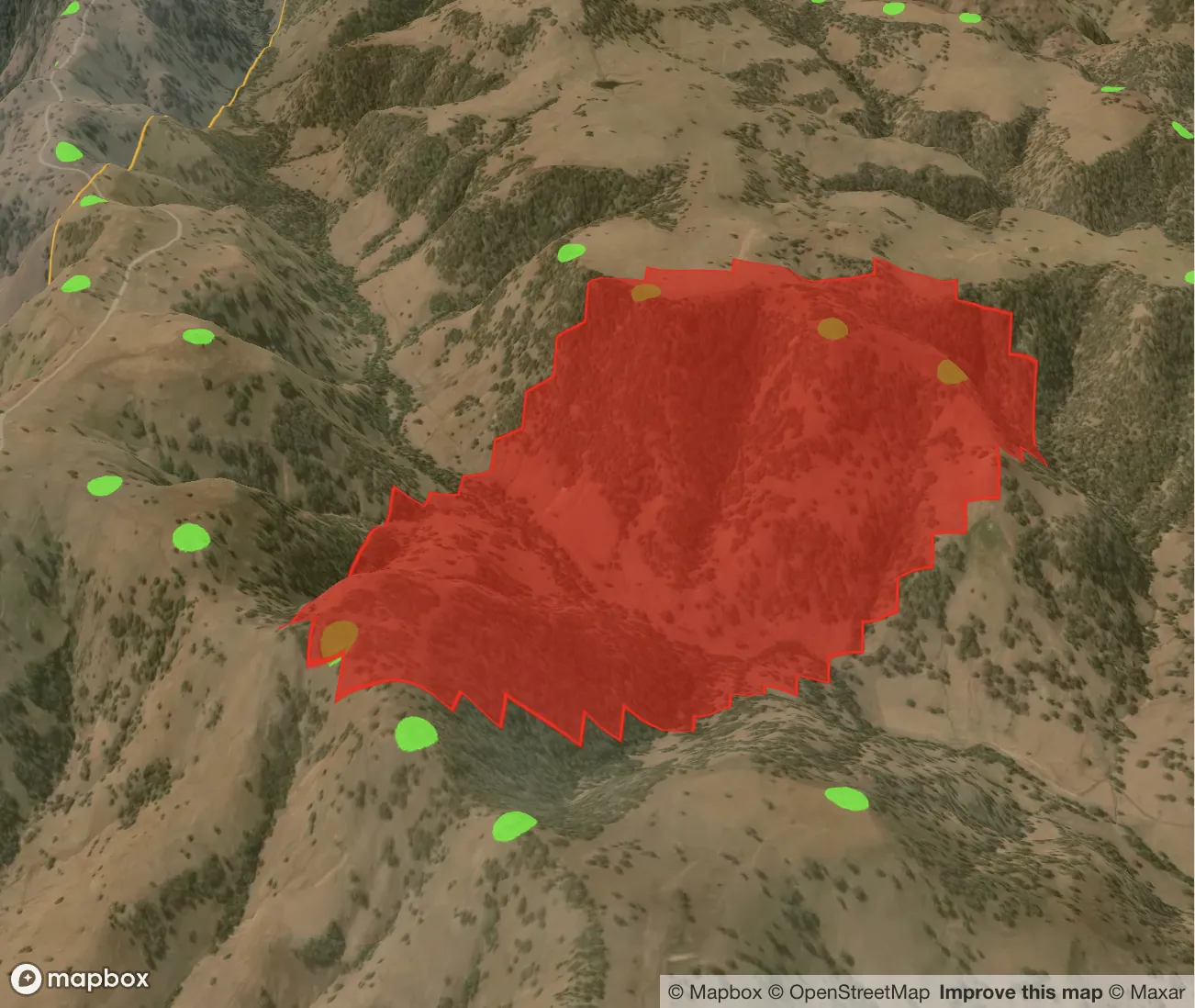
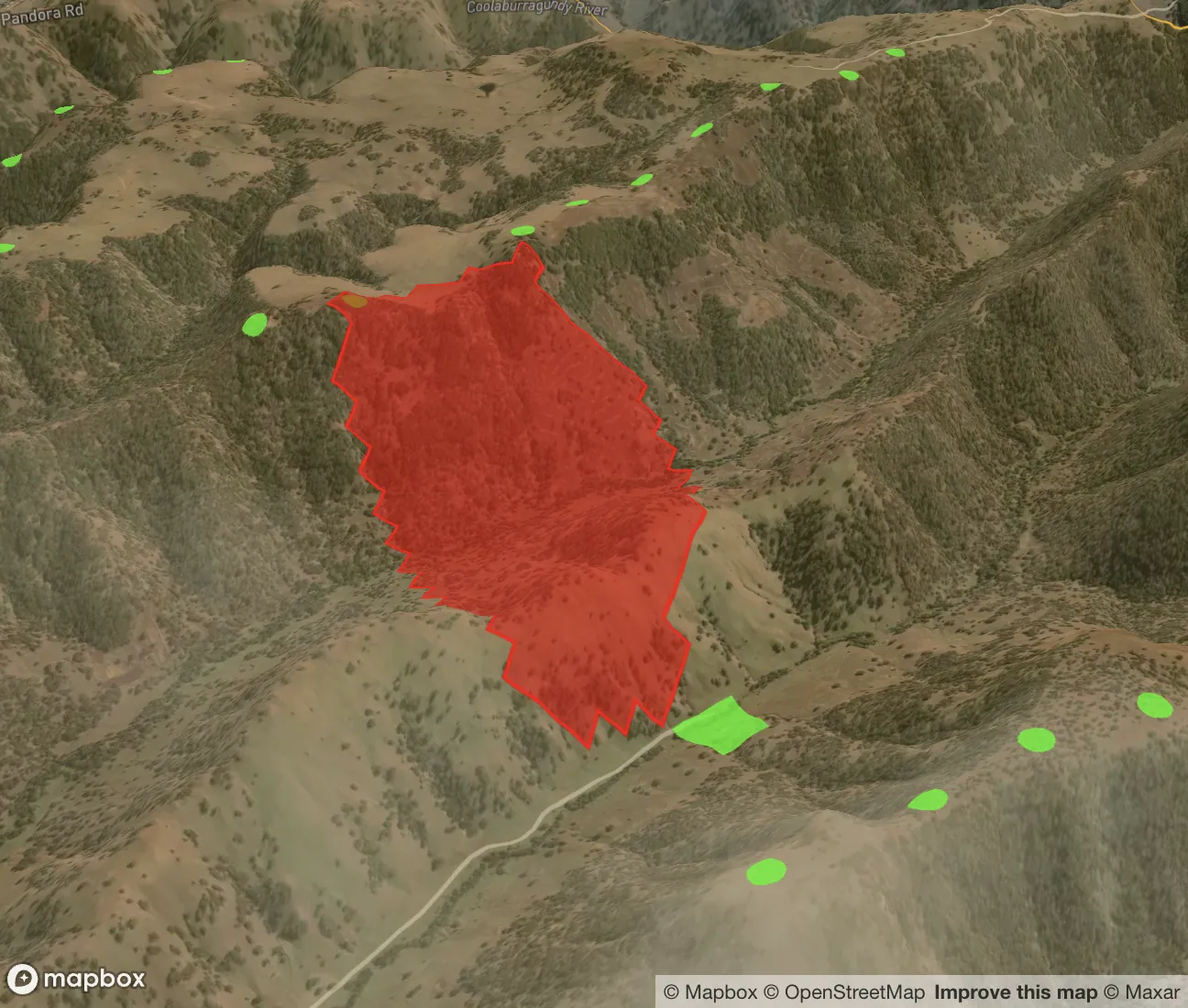
This is the analysis that tells an asset manager where to prioritise maintenance: not on the turbines that are most likely to fail, but on the ones where a failure carries the highest consequence.
For a project of this scale, that moves asset management from broad-scale guesswork to a precise, data-driven strategy — one that supports both operational continuity and the protection of the communities living around the site.
Note — This analysis was not a paid or affiliated engagement. FiSci chose the Liverpool Range Wind Farm project as a public-facing example to test and showcase the predictive and prescriptive capability of the Mitigate platform in a high-consequence infrastructure environment.